Dry Rental vs Rental With Refill: Which Vending Machine Model Fits Your Workplace? [Aug’26]
July 28, 2026How Many Vending Machines Does Your Office Need? [Aug’26]
August 20, 2026
Yes — you can have a vending machine in your office without buying one. You rent it on a monthly basis: the vendor owns the machine, installs it at your site and maintains it, and you pay a fixed monthly rent against a GST invoice. Fraxotic’s machine-only rental starts from ₹15,000 per machine per month plus GST, on a 12-month minimum agreement — the machine stays the vendor’s property and never enters your fixed-asset register.
If you are the admin, facilities or HR manager who has been asked to “get a vending machine for the floor”, this guide covers what your options actually are in India, what a rental includes, what your office still has to do, and the questions to ask before you sign anything.
The three ways to get a vending machine into an office
1. Buy the machine outright
You purchase the unit as a capital asset. Fraxotic’s own published catalogue range for machine purchase runs roughly ₹1 lakh to ₹2.5 lakh depending on model — a mini unit sits at the lower end, a large touchscreen combo at the upper end. That is a one-time cost, and after that the machine is yours.
Works when: you have capex budget approved, you plan to keep the machine for many years, and you have someone in-house who can arrange repairs.
The catch: capex approval in most Indian companies is slower than opex approval. You also own the depreciation, the asset register entry, the spares problem and the resale problem. If the machine breaks in year three, that is your cost and your vendor hunt.
2. Rent the machine only
You pay a fixed monthly rent. The vendor supplies the machine, installs it, and maintains it under a written service agreement. You stock it with whatever products you want, and you keep 100% of the product revenue — the vendor takes no cut of sales and does not refill.
Works when: you want the machine treated as a monthly operating cost, you want control over what goes in it (snack brands, healthier options, your own branded items, subsidised pricing for employees), and you want maintenance to be someone else’s contractual obligation.
The catch: stocking is genuinely your job. Someone in the office has to own it. If nobody owns it, the machine sits empty and everybody blames the machine.
3. Fully-managed / operator model
An operator places the machine free or near-free, stocks it themselves, and keeps the sales revenue. Your out-of-pocket cost is minimal or zero.
Works when: you want zero effort and zero budget line, and you do not care much what is sold or at what price.
The catch: you lose control. The operator decides the product mix and the price, because their margin depends on it. You cannot easily subsidise items for employees, run a healthy-snacks policy, or stock your own brand. Restocking frequency is at their discretion, not yours — and if their route schedule slips, your floor notices before they do.
Comparison: buy vs machine-only rental vs fully-managed
| Buy outright | Machine-only rental | Fully-managed operator | |
|---|---|---|---|
| Upfront cost | High — roughly ₹1L–₹2.5L per machine (Fraxotic catalogue range, varies by model) | Low — monthly rent, no purchase | Little to none |
| Monthly cost | Nil, plus repair costs as they arise | Fixed rent from ₹15,000/machine/month + GST (Fraxotic) | Typically nil to the office |
| Who stocks it | You | You | The operator |
| Who keeps sales revenue | You — 100% | You — 100% | The operator |
| Who chooses products & pricing | You | You | The operator |
| Maintenance | Your problem, or a separate AMC | Included in the rental under a written service commitment | The operator’s |
| Who owns the asset | You — it goes on your books | The vendor — stays off your fixed-asset register | The operator |
| Best for | Long horizon, capex already approved, in-house upkeep capability | Offices that want control of the product mix without a capital purchase | Offices that want zero involvement and accept zero control |
Capex vs opex: why this is usually a procurement question, not a snack question
The reason most office managers end up renting is not the machine — it is the approval route. A purchase is a capital expenditure: it needs capex sign-off, it enters the fixed-asset register, and finance then carries it through depreciation for years.
A rental is an operating expense. It is a predictable monthly line item billed on a GST invoice, so it is claimable as a business expense in the ordinary way, and because the machine remains the vendor’s property it never becomes an asset you have to track, depreciate or eventually dispose of. In practice, a ₹15,000/month opex line is a shorter conversation internally than a ₹2 lakh capex request.
One caveat, stated plainly: treat the above as the commercial shape of the arrangement, not as tax advice. Confirm the exact accounting and input-credit treatment with your own finance team before you build it into a budget.
What a machine-only rental actually includes
- The machine itself, delivered and installed at your site.
- Maintenance and service for the life of the agreement, under a written commitment. Fraxotic’s is 99.58% monthly uptime, with priority-one issues acknowledged within four business hours, an on-site visit within 24 hours in metro locations and 48 hours in non-metro locations, and resolution targeted within 48–72 hours on working days.
- Ownership stays with the vendor. The machine is Fraxotic’s property throughout.
- Cashless payment support, including UPI, so you are not managing coin floats.
- A GST invoice every month, which is what makes it a clean operating expense.
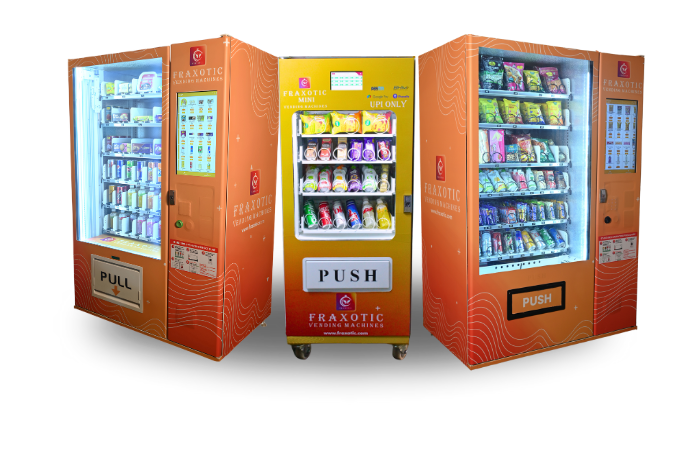
- Machine choice — Mini, Snacks & Beverage, Cashless Combo, Elevator, or the 22″ touchscreen Luxury unit, matched to your floor and footfall.
What it does not include, and you should be clear about this before you present it internally: refilling. Fraxotic supplies and maintains the machine and takes no share of your product sales. The stock, and the profit on the stock, are both yours.
What your office still has to do
- Decide the product mix. Snacks, beverages, or both. Whether you subsidise for employees or sell at MRP. Whether you want a healthier set of options.
- Source and stock the products. Usually the same channel your pantry supplies already come through.
- Nominate an owner. One named person — typically from admin or facilities — who checks stock levels, handles the reorder, and is the single point of contact with the vendor. This is the step offices skip, and it is the step that decides whether the machine works.
- Set a refill rhythm. Weekly is a reasonable starting point; adjust once you see what actually sells on your floor.
Site requirements to check before you enquire
Have these answers ready and the site assessment goes faster.
- Power: a dedicated, earthed power point close to the intended spot. Not an extension board shared with three other appliances.
- Floor space and clearance: the footprint of the machine plus room for someone to stand and use it, and room to open it fully for refilling and service.
- Access route: how the machine physically gets in — lift dimensions, doorway widths, ramps, stairs. Worth measuring before installation day rather than on it.
- Footfall: a spot people already walk past — near the pantry, the break area, or the lift lobby. A machine in a corridor nobody uses will underperform regardless of what is in it.
- Security and hours: who has access after hours, and whether the area is covered by CCTV.
- Refill logistics: where stock will be stored and who physically loads it.
- Landlord or building permission, if you are a tenant in a managed building.
How the procurement conversation usually goes
- Enquiry and requirement discussion — headcount, floors, what you want dispensed, which locations.
- Site assessment — the vendor checks placement, power, access and footfall, and recommends a machine model.
- Quote — monthly rent per machine plus GST, with the service commitment stated.
- Agreement — 12-month minimum term with Fraxotic, monthly billing, an optional discount if you pay annually in advance, and a 2–3 month exit notice applicable after the lock-in period.
- Installation and handover — machine placed, configured for cashless payment, and your nominated owner walked through loading and basic operation.
If you are a government department or a PSU, note that Fraxotic is GeM-registered, so procurement can run through the standard GeM route rather than a separate vendor empanelment exercise.
Questions to ask any vending vendor before you sign
- What is your written uptime commitment, and is it in the agreement or only in the sales deck?
- What are your response and resolution timelines for a breakdown, and do they differ for metro and non-metro sites?
- Who owns the machine during the term, and who bears the cost if it fails?
- Do you take a share of product sales? If yes, how is it calculated and audited?
- Who refills, and if it is you, at what frequency and at whose cost?
- What is the lock-in period and the exit notice? What happens if we relocate offices mid-term?
- Is billing on a GST invoice, monthly?
- Is a deposit or advance required, and what are the payment terms? Ask this explicitly at quote stage — it varies by vendor and by deal.
- What payment modes does the machine support — UPI, cards, contactless?
- What happens at the end of the term — renewal, machine upgrade, or removal?
Getting started
If a monthly rental is the shape that fits your approval process, the practical next step is a site assessment. You can read the commercial terms in detail on the vending machine on rent page, or see how multi-floor and multi-site deployments are handled under corporate vending solutions for offices and institutions.
For city-specific coverage and installation, see vending machine rental in Pune, vending machine rental in Mumbai, or vending machine rental in Bangalore. Fraxotic also serves Thane, Navi Mumbai, Nashik, Nagpur, Aurangabad and wider Maharashtra, along with Delhi NCR, Hyderabad and Chennai.
Fraxotic Innovations Pvt. Ltd. has been operating from Wakad, Pimpri-Chinchwad, Pune since 2019, with 1,000+ machines deployed for corporates, large firms, institutions and government departments. To discuss a site, WhatsApp +91 77768 38868 or write to wecare@fraxotic.com.
Frequently Asked Questions
Can I get a vending machine for my office without buying one?
Yes. Vending machines are available on monthly rental, where the vendor owns the machine and you pay a fixed monthly rent. Fraxotic's machine-only rental starts from ₹15,000 per machine per month plus GST. The machine remains Fraxotic's property throughout the agreement, so it does not enter your fixed-asset register.
How much does it cost to rent a vending machine for an office in India?
Fraxotic's rental starts from ₹15,000 per machine per month plus GST, with the exact figure depending on the machine model you choose — Mini, Snacks & Beverage, Cashless Combo, Elevator or the 22" touchscreen Luxury unit. Billing is monthly on a GST invoice. There is an optional discount if you pay annually in advance.
Who stocks the machine and who keeps the money from sales?
In Fraxotic's machine-only rental model, your office stocks the machine with products of your choosing, and you keep 100% of the product revenue. Fraxotic does not refill the machine and takes no share of product sales. This is different from a fully-managed operator model, where the operator stocks the machine and keeps the sales income.
Who handles maintenance and repairs on a rented machine?
Fraxotic does, under a written service commitment for the duration of the agreement — 99.58% monthly uptime, priority-one issues acknowledged within four business hours, an on-site visit within 24 hours in metro locations and 48 hours in non-metro locations, with resolution targeted in 48–72 hours on working days. Since the machine remains Fraxotic's property, the repair cost is not yours to carry.
What is the minimum contract length?
Fraxotic rentals run on a 12-month minimum agreement, billed monthly. After the lock-in period, exit requires 2–3 months' notice. If there is any chance your office will relocate mid-term, raise that at quote stage so it can be discussed before signing.
Is a deposit or advance payment required?
Deposit and payment terms are confirmed at quote stage and can vary by deal, so ask about them explicitly before signing. What is fixed is the billing structure: monthly invoicing with GST, and an optional discount if you choose to pay annually in advance.
Is rent treated differently from buying a machine, for accounting purposes?
The plain commercial facts are these: rent is billed monthly on a GST invoice as an operating expense, and because the machine remains Fraxotic's property it never enters your fixed-asset register, so there is no depreciation for you to manage. A purchase, by contrast, is a capital expenditure on your books. Confirm the exact accounting and input-credit treatment with your own finance team.
Can government departments and PSUs procure through the usual route?
Yes. Fraxotic is GeM-registered, so government buyers can procure through the standard Government e-Marketplace process rather than running a separate vendor empanelment. Fraxotic serves corporates, large firms, institutions and government bodies — not individual or retail customers.