Vending Machine Rental Price in India [Aug’26]
July 28, 2026How to Get a Vending Machine for Your Office Without Buying One [Aug’26]
July 28, 2026
Dry rental means you rent the vending machine only. The company that owns the machine installs it and maintains it; you stock it with your own products, set your own prices, and keep 100% of the product revenue. Rental with refill (also called fully-managed or fully-stocked vending) means the operator supplies the machine and the products, decides the product mix and the prices, and keeps the margin on everything sold.
Both are legitimate models and both are widely sold in India. Indian B2B marketplaces list vending machine rentals under both “Dry Rental” and “Rental With Refill” as separate categories, which tells you the market already distinguishes them — even if very few vendors explain the difference clearly before you sign. This post is that explanation.
What dry rental actually means
In a dry rental, the transaction is simple: you are paying rent for a machine, plus a service commitment to keep it running. Nothing else changes hands.
- You stock it. Your admin or facilities team, or your existing pantry vendor, loads the machine with whatever your staff actually wants.
- You price it. Cost price, canteen rate, subsidised, or free-vend — your call.
- You keep the revenue. Every rupee collected by the machine is yours. The rental company takes no cut of sales.
- The vendor maintains it. Servicing, spares, breakdown response, and uptime remain the machine owner’s responsibility.
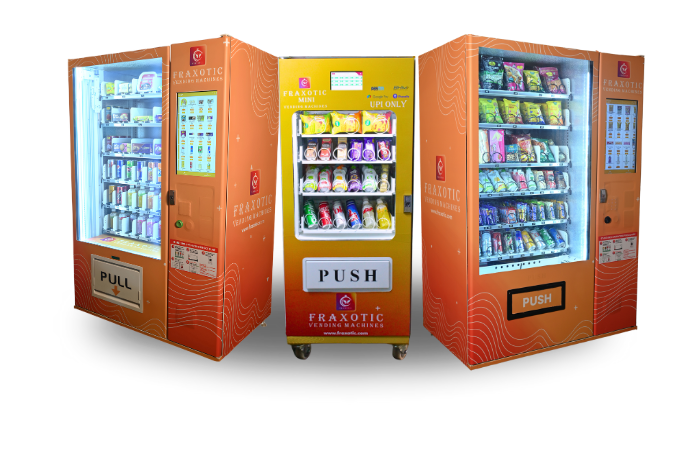
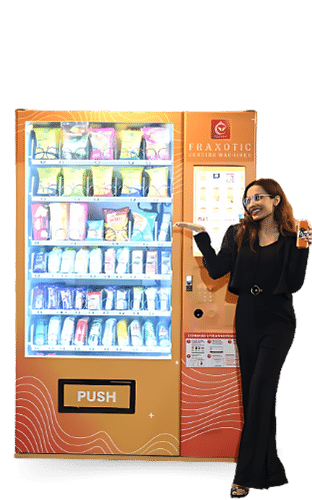
This is the model Fraxotic runs for vending machines on rent. Fraxotic Innovations Pvt. Ltd. has operated from Pune (Wakad, Pimpri-Chinchwad) since 2019 with 1,000+ machines deployed, and rents machines from ₹15,000 per machine per month plus GST — machine and maintenance only. Fraxotic does not refill the machine and takes no share of what it sells.
What rental with refill means
In a fully-managed arrangement, the operator runs the machine as their own retail point that happens to sit in your building. Fully-managed operators work this way — they place the machine, stock it from their own supply chain, and manage replenishment. Some operators advertise rental starting from around ₹8,000 per month.
Your side of the deal is: give floor space, give power and internet, and let staff buy. Nothing else is asked of you — and for a lot of sites that is exactly the point.
The economics: why fully-stocked rent looks cheaper
The headline rent in a managed model is usually lower than a dry rental rent, and the reason is structural rather than a discount.
In rental with refill, the products are the business. The operator earns the margin on every packet of chips and every bottle of cold drink sold through that machine, month after month. The machine is simply the shelf that makes those sales possible. A low rent — sometimes a nominal one, sometimes zero at high-footfall sites — is worth paying for, because the recurring margin is where the money is.
In a dry rental, that margin does not exist for the vendor. The rent is the entire revenue from that machine, so it has to cover the hardware, the spares, the service engineers and the uptime commitment on its own. That is why the monthly figure is higher.
Neither number is the real cost. To compare honestly, look at the total: dry rental costs you rent plus your own product purchases, and returns you the full sale value. Managed vending costs you a lower rent and returns you nothing on the products, because the retail margin sits with the operator. Which comes out ahead depends entirely on your volume — the higher the consumption at a site, the more that product margin matters, and the more it favours holding it yourself.
Control over product mix and pricing
This is the part that decides the question for most corporate buyers, and it has nothing to do with the rent.
In a managed model, the operator’s catalogue is the catalogue. It is chosen for their margin and their supply chain, priced at their MRP-linked retail rates, and changed on their schedule.
In a dry rental, you decide:
- Canteen-rate pricing. Sell at cost, or a few rupees above, instead of retail. The machine becomes an extension of your canteen rather than a shop.
- Company-subsidised snacks. Set a partial price, or run some SKUs at zero as a staff benefit. Only possible when you control the pricing engine.
- Dietary and regional preferences. Jain and pure-veg options, Indian regional snacks, sugar-free lines, protein items for a young engineering floor — stock what your people actually eat, not what sells fastest on a national average.
- Shift and site realities. Night-shift teams, plant floors and hospital blocks need different stock from a sales office. You can rotate it yourself.
- Non-food items. Dry rental is the only sensible model for anything the operator does not retail. PPE vending machines for industries dispensing gloves, earplugs and safety glasses against employee ID are stocked from your own consumables store, because those are your inventory and your compliance record.
No vendor is deciding what your staff can buy, and no vendor is taking a retail margin off your own employees.
Side-by-side comparison
| Factor | Dry rental | Rental with refill |
|---|---|---|
| Who stocks the machine | You (your admin, facilities or pantry vendor) | The operator |
| Who sets prices | You — cost, canteen rate, subsidised or free | The operator, at their retail rates |
| Who keeps product revenue | You keep 100% | The operator |
| Monthly rent level | Higher — rent is the vendor’s only revenue (Fraxotic: from ₹15,000/machine/month + GST) | Lower, sometimes nominal — the operator earns on products |
| Maintenance and uptime | Vendor’s responsibility, under a written service commitment | Operator’s responsibility |
| Contract | Typically a fixed term; Fraxotic uses a 12-month minimum with monthly billing | Varies; often shorter or footfall-dependent |
| Effort required from you | Ongoing — someone must own stock, refill and cash/UPI reconciliation | Close to zero |
| Product range | Anything you choose, including non-retail items like PPE | The operator’s catalogue |
| Best for | Sites with real volume, an existing admin/pantry function, or a need to control price and mix | Small offices, no stock owner, low volume, zero-effort requirement |
Who each model suits
Dry rental fits you if
- You already have an admin, facilities or pantry team that handles consumables.
- Consumption is high enough that the product margin is worth holding.
- You want canteen-rate or subsidised pricing as an employee benefit.
- Your staff have specific dietary, regional or shift-based needs.
- You need to dispense items no vending operator retails — PPE, consumables, tools, stationery.
- You are an institution or a government body that needs the machine on a clean rental line item, with GST invoicing and a procurement-friendly paper trail. Fraxotic is GST-invoiced and GeM-registered for exactly this reason.
- You want corporate vending solutions across multiple sites under one uniform commercial structure.
Rental with refill fits you if
- You are a small office with nobody who can own stock. This is a genuine constraint, not a weakness — if refilling would fall to whoever is free that day, it will not get done.
- Footfall is low and the product margin would not be worth the administrative overhead.
- You want a single line item and zero operational involvement.
- You are testing whether staff will use a machine at all before committing to anything.
- You have no space to hold stock, or no secure place to keep it.
When dry rental is NOT for you
Being direct about this, because signing the wrong model wastes twelve months:
- Nobody owns the stock. If you cannot name the person responsible for refilling before you sign, the machine will sit empty and you will still be paying rent. An empty dry-rental machine is the single most common failure mode.
- Low consumption. Below a certain volume, the product margin you gain does not offset the higher rent and the effort. Do the arithmetic with realistic numbers, not optimistic ones.
- You do not want the working-capital cycle. Dry rental means you buy inventory upfront, hold it, track expiry, and reconcile collections. That is a small but real finance process.
- Short-term or uncertain sites. A 12-month minimum is a poor fit for a temporary office or a site you may vacate.
- You want the vendor to solve everything. If “zero effort” is the actual requirement, say so, and take a managed model. Dry rental will disappoint you.
Questions to ask any vending vendor before signing
- Which model is this, precisely? Ask it in plain words: who stocks the machine, and who keeps the money from sales? Get the answer in the agreement, not on a call.
- Is there any share of sales? Some arrangements are dry rental in name but include a revenue share or a minimum-consumption clause. Read for it.
- What is the written uptime commitment, and what happens when it is missed? A verbal “we’ll come quickly” is worth nothing. Fraxotic commits in writing to 99.58% monthly uptime, with priority-1 issues acknowledged within a defined business-hours window, on-site attendance within one working day in metros and two in non-metros, and resolution targeted within two to three working days.
- Who pays for spares, consumables and wear parts? Ask specifically about the payment/cashless module, the cooling unit and the vend motors.
- What is the lock-in and the exit process? Fraxotic uses a 12-month minimum with a two-to-three month notice period after lock-in. Know your equivalent before you sign.
- Who owns the machine? In a rental, it stays the vendor’s property. That matters for your asset register and for insurance.
- Is GST invoiced properly, and can it be procured through your channel? For government and PSU buyers, ask about GeM registration specifically.
- Can the machine do what you need? Cashless-only, chilled beverages, large-format, ID-linked dispensing for PPE — confirm against the actual model offered, not the brochure. Fraxotic’s range covers Mini, Snacks & Beverage, Cashless Combo, Elevator, and a Luxury 22″ touchscreen unit.
- What happens if the site relocates? Ask whether machines can be moved and what that costs.
The short answer
If someone at your site will own the stock, dry rental gives you control of the price, the product mix and the entire product revenue, at a higher monthly rent. If nobody will own the stock, rental with refill is the right answer and the lower rent is real. The failure is not choosing the “wrong” model in the abstract — it is choosing dry rental without a person to run it, or choosing managed vending and then being frustrated that you cannot subsidise a samosa.
Fraxotic operates the dry rental model only, for corporates, large firms, institutions and government buyers, from ₹15,000 per machine per month plus GST. If you want to work through the numbers for your site, or compare a snack and beverage vending machine lease against your current pantry spend, talk to us on WhatsApp at +91 77768 38868 or write to wecare@fraxotic.com.
Frequently Asked Questions
What is dry rental in vending machines?
Dry rental means you rent the vending machine only — the rental company installs and maintains it, but you stock it with your own products. You set the prices and keep 100% of the product revenue. The rental company takes no share of sales and does not refill the machine. Indian B2B marketplaces list this as a distinct vending rental category.
What is the difference between dry rental and rental with refill?
The difference is who supplies the products and who keeps the margin on them. In dry rental you stock the machine, set prices and keep all sale proceeds, paying a higher monthly rent. In rental with refill the operator stocks the machine, sets the prices and keeps the product margin, which is why the rent is lower.
Who refills the machine in a dry rental?
You do — typically your admin or facilities team, or your existing pantry or housekeeping vendor. The rental company's responsibility is the machine itself: servicing, spares, breakdown response and uptime. Before choosing dry rental, name the person who will own refilling; an unstocked machine is the most common way this model fails.
Who keeps the money the machine collects?
In dry rental, you do. Every rupee collected through cash or UPI is yours, because you bought the stock. Fraxotic, for example, takes no share of sales at all — its revenue is the monthly rent. In a fully-managed model the collections belong to the operator, who supplied the products.
Which model is cheaper?
Rental with refill has the lower headline rent — Some fully-managed operators advertise from around ₹8,000 per month, while Fraxotic's dry rental starts at ₹15,000 per machine per month plus GST. But rent is not the full cost. Dry rental returns the entire product revenue to you, so at higher consumption the total position often favours it. Work it out with your own volume figures.
Can I switch from one model to the other later?
In practice yes, but not mid-contract. Both models are usually sold on fixed terms — Fraxotic's dry rental has a 12-month minimum with a two-to-three month notice period after lock-in — so switching means running out or exiting your current agreement first. If you are unsure which suits you, agree the term length before you sign rather than after.
Is GST charged on vending machine rental, and can government buyers procure it?
Rental is invoiced with GST, and Fraxotic's quoted rate of ₹15,000 per machine per month is exclusive of GST. Fraxotic invoices under GST and is GeM-registered, which is the procurement route most government departments and PSUs require. Confirm both points with any vendor before raising a purchase order.
Does dry rental work for non-food items like PPE?
Yes, and it is usually the only workable model for them. Vending operators retail snacks and beverages, not gloves, earplugs or safety glasses, so a fully-managed vendor generally cannot supply them. With dry rental you load the machine from your own consumables store and keep the dispensing record against employee ID for compliance.