PPE Vending Machines in Indian Factories: How Controlled Dispensing Works & Why Plants Rent Them [Aug’26]
August 20, 2026
A vending machine needs a standard 16A single-phase power socket – the same kind used for an AC or geyser – and about 3×3 ft of floor space near that point. There’s no three-phase or special wiring involved. Your actual running cost depends on whether the machine is refrigerated, how it’s placed, and your local tariff; further down is a simple formula so you can work out your own number instead of trusting a generic figure.
The basic electrical requirement
Every vending machine, refrigerated or not, runs on single-phase domestic-type supply. What it needs from the site is straightforward: a standard 16 AMP socket – the same rating used for split ACs and geysers in most Indian offices and residential complexes – within reach of where the machine will stand. No dedicated circuit, no three-phase line, no electrician-grade rewiring. If your office already has an AC point in the pantry or breakout area, you likely already have what a machine needs.
Where this trips people up is when the socket is on the wrong wall, or shared with something else that trips the breaker under load. Before installation, confirm the point is on its own circuit (or at least not shared with heavy equipment like a water cooler or microwave), and that it’s not at the far end of an extension board strung across the floor. A loose or overloaded extension is a common cause of nuisance trips at newly installed sites.
Placement rules that quietly affect consumption
Where you put the machine changes how hard it has to work, which changes what it draws. This matters more for refrigerated units than for snack-only machines. Three placement rules worth following:
- Keep it out of direct sun and away from heat sources. A machine standing next to a window with afternoon sun, or backed up against a kitchen wall, works its compressor harder to hold temperature – that’s higher draw for the same amount of cooling.
- Leave ventilation clearance. Compressor-based units exhaust heat from the back or sides. Push a fridge-type machine flush against a wall or into a tight alcove and it recirculates its own hot air, again forcing the compressor to run longer per cycle.
- Use a level, stable floor. This one’s about the mechanism, not power draw directly – an uneven base stresses the coin/note validator and dispensing motors over time, which is a service issue rather than an electricity one, but it’s worth getting right at install.
For exact footprint numbers by machine type, see our breakdown on how much space a vending machine needs.
Refrigerated vs non-refrigerated: why the draw is different
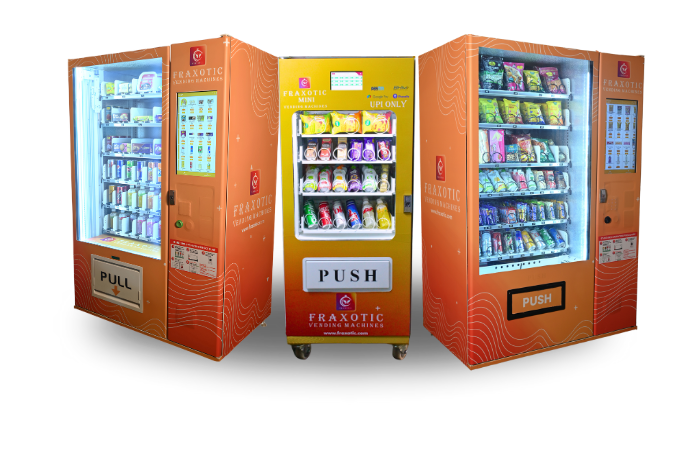
Our range spans Mini, Cashless Combo, Snacks & Beverage, Luxury (with a 22-inch touchscreen), and Elevator machines. The single biggest factor separating their power profiles is whether the unit refrigerates.
A refrigerated machine runs a compressor, much like a household fridge, and that compressor cycles on and off to hold a set temperature. What drives how often it cycles – and therefore how much it draws over a month – is:
- Ambient temperature – a machine in a non-air-conditioned corridor works harder than one in a cooled lobby.
- Door/flap openings – every dispense that lets warm air in makes the compressor recover.
- Stocking level – a fuller machine holds cold better than a near-empty one, similar to a fridge.
- Lighting and display – internal lighting and, on Luxury units, the touchscreen add a smaller but constant load on top of refrigeration.
- Footfall – a high-traffic machine cycles its door and dispense mechanism more often through the day.
Non-refrigerated machines (snack-only Mini or Cashless Combo configurations without a chiller) skip the compressor entirely, so their draw is limited to lighting, the payment terminal, and the dispensing motor – meaningfully lower and far more predictable than a refrigerated unit.
How to estimate your own monthly electricity cost
We’re not going to hand you a made-up wattage figure for “a vending machine” – it depends on the model, the compressor, and everything above, and any single number presented as universal would be misleading. Instead, here’s the formula, taken straight from how electricity billing works, that you can apply once you know your own machine’s rating and your tariff.
Step 1 – find the average power draw. Check the rating plate on the machine (usually inside the service door or on the back panel) for its power rating in kW. Because compressor-based units cycle on and off rather than running flat out, the plate figure is a ceiling, not the average draw – the real average over a day is lower.
Step 2 – convert to monthly units (kWh).
units per month = average power draw (kW) x 24 (hours) x 30 (days)
Step 3 – apply your tariff.
monthly cost = units x your per-unit tariff (₹/unit, from your electricity bill)
Worked example – assumed inputs only, not a Fraxotic-published spec: assume for illustration a machine averaging 0.3 kW and a commercial tariff of ₹10/unit. That gives 0.3 x 24 x 30 = 216 units, and 216 x ₹10 ≈ ₹2,160/month. Your actual figures will differ – check the rating plate on your specific machine and the commercial tariff slab on your own electricity bill, since both vary by machine model and by state/discom.
For what a machine costs to have on-site beyond electricity, see our vending machine rental price in India breakdown.
Who pays the electricity bill in a rental
Under a dry rental – where we provide the machine and maintenance, and you stock your own products – standard practice is that the site pays for the electricity the machine draws, the same way it would pay for the AC or the lighting in that room. The rent itself (from ₹15,000/machine/month + GST) covers the hardware and its upkeep, not the power it consumes, because that consumption depends entirely on your site’s placement, footfall, and tariff – none of which we control from our end.
This is worth stating plainly upfront so facility teams can budget for it alongside the rent line, rather than discovering it on the first electricity bill after installation. If you’re comparing that against buying a machine outright, our note on going office vending without buying covers the full cost picture, electricity included.
Voltage fluctuation and why a stable line matters
Compressor-based equipment is sensitive to voltage swings – a brownout or a spike can shorten the compressor’s working life or trip the machine’s internal protection, taking it offline until it’s reset. If your building has a history of fluctuating supply (common in some older commercial complexes, especially during peak load hours), it’s worth having a voltage stabilizer or a stable, dedicated line feeding the machine’s socket, the same precaution you’d take for a server room AC.
This isn’t something we can diagnose remotely – it’s a site electrical characteristic – but it’s a common preventable cause of an otherwise healthy machine going down. Under the written SLA (99.58% monthly uptime, with preventive maintenance every six months), our service visits can flag repeat trip patterns if they show up, but a stable supply from day one avoids the downtime in the first place.
Install checklist before the machine arrives
- 3×3 ft of clear, level floor space at the intended spot
- A working 16A socket within reach of that spot, ideally on its own circuit
- Ventilation clearance on the back/sides for refrigerated units – not flush against a wall
- No direct sunlight or proximity to another heat source (kitchen, heater)
- A stable supply line, or a stabilizer if your building has known voltage fluctuation
Frequently asked questions
Does a vending machine need three-phase power?
No. Every machine in our range runs on standard single-phase domestic-type supply, the same as a home AC or geyser – no three-phase connection or special wiring is required.
What socket does a vending machine need?
A standard 16 AMP socket, positioned within reach of where the machine will stand, ideally not shared with other heavy appliances on the same circuit.
Do non-refrigerated machines use much less power than refrigerated ones?
Yes, meaningfully less. Refrigerated units run a compressor that cycles continuously to hold temperature, which is the dominant part of their draw. Non-refrigerated (snack-only) machines skip that entirely and draw only for lighting, the payment terminal, and the dispensing motor.
Who pays for the electricity a rented machine uses?
Under our dry rental model, the site pays for the electricity, the same way it covers power for its own lighting or AC. The rental fee covers the machine and its maintenance, not its power consumption.
How much floor space does a machine need alongside the power point?
About 3×3 ft per machine, with the power point reachable from that footprint. Exact dimensions vary slightly by model – see our detailed space requirement guide.
Can I calculate my exact monthly electricity cost before installing?
Not precisely, since draw depends on your site’s ambient temperature, footfall, and stocking pattern – but you can get a workable estimate using the formula above once you have the rating-plate figure and your own tariff.
What happens if my building has unstable voltage?
It’s worth adding a stabilizer or routing the machine to a more stable line before installation – voltage swings are a common preventable cause of compressor faults and unplanned downtime.
Does the touchscreen on the Luxury machine add much to the power draw?
It adds a small, constant load on top of refrigeration – noticeable in the rating-plate figure but not a major factor compared to compressor cycling and ambient conditions.
If you’re budgeting a machine for your office and want the exact requirements confirmed for your site – socket location, floor plan, and which model fits your footfall – reach out on WhatsApp at +91 77768 38868 or explore our vending machine on rent plans, and we’ll walk the electrical checklist with you before the machine ships.